GarmentFlow ERP · Planning
Commit to a delivery date you can actually hit
The plan comes from the confirmed orders, and capacity is counted in minutes your lines have actually produced — not in a spreadsheet somebody keeps on a laptop. Load the lines, see the bottleneck before it happens, and know what accepting one more order does to the eleven you already took.
Where the plan comes from
Confirmed orders, not a spreadsheet
Confirming an order creates the production order and the fabric requirement. Planning works from those, so the plan and the order book cannot drift apart — and nobody is planning against a version somebody emailed last Tuesday.
Capacity
Capacity in minutes, not in wishes
A line's capacity is its operators, their hours and the efficiency it actually runs at. A style's load is its standard minutes. Both come from what has already happened on your floor, so the plan is arithmetic rather than optimism.
Loading
Load the lines, see the bottleneck
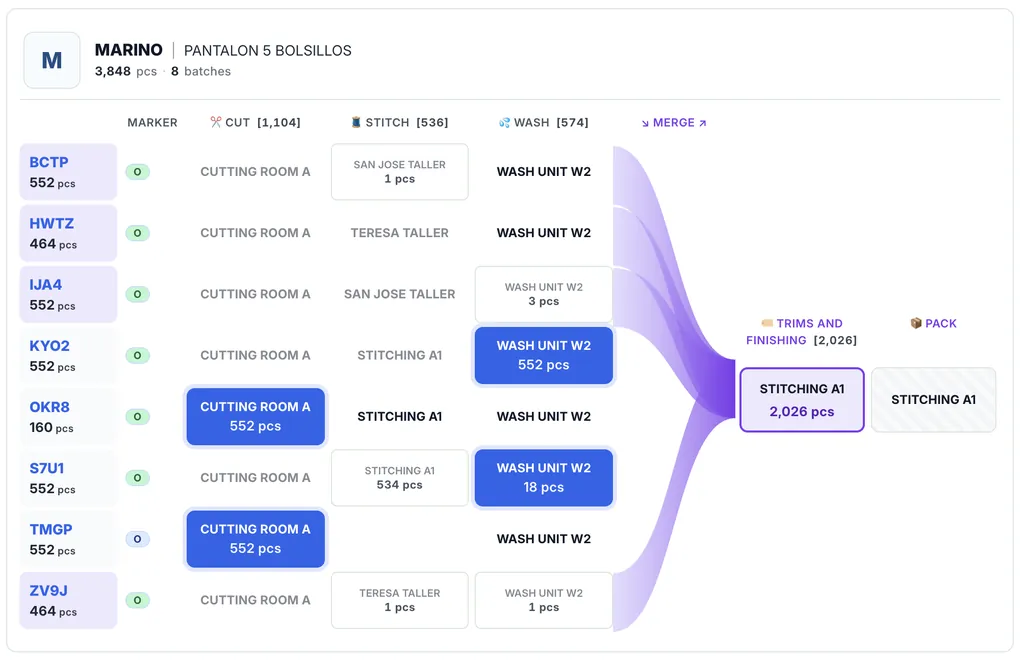
Orders drop onto lines and weeks. Where the load goes past the capacity the week turns red, weeks before anybody would have noticed on a whiteboard. Move it, split it across two lines, or send part of it out.
Cutting
A cut calendar the store can buy against
When each order cuts sets when its fabric has to be in the building. Purchasing works backwards from the cut date and the lead time, instead of from a phone call on the morning of the spread.
What-if
Change one order, see what it costs the rest
A buyer pulls a delivery forward, or a fabric lands two weeks late. Simulate it before you answer: what moves, what slips, and which line ends up idle. Then commit, or say no with a reason.
65% → 87% on-time delivery
At INDOPAR, since planning stopped happening on a whiteboard.
Connected to the rest
Planning sits between the order book and the floor. It takes confirmed orders, tells materials when fabric has to land, hands production the sequence, and gives costing the capacity a style was quoted against.
Questions
We plan on a whiteboard. Why change?
Keep it. A board shows what is planned; this shows what is possible — how many minutes a line has left, and which week is already over-committed.
Where do standard minutes come from?
From the operations on the style, and from what the line actually scanned the last time it ran. A style with no history uses your estimate until it has one.
Can I plan across two factories?
Yes — lines belong to production units, and an order can be split across units or sent to a subcontractor from the same plan.
Priced by the size of your factory, not per user
Unlimited users on unlimited devices, every plan.
- Studio $179
- Factory M $450
- Factory L $900
- Factory XL $1,800
- Enterprise talk to us
Book a walkthrough
See your factory in GarmentFlow ERP.
Twenty minutes, no slides, a real factory's data on screen. We reply within one business day.
Faster on WhatsApp?
Message us →