GarmentFlow ERP · People
HR and payroll software for garment factories
Payroll in a garment factory is rarely one method. Some operations are paid by the piece, some people are on a day rate, overtime is calculated differently again, and the statutory side changes by country. Meanwhile the largest cost in the factory is labour, and most factories can tell you the monthly total but not which order it belonged to.
Piece work
Paid by the piece, costed by the piece
Assembly operations, costed by quantity and the standard minutes per unit. The pieces go in on the batch card, and the labour cost follows — there is no separate calculation to keep.
Day work
Hours, overtime and the rules that go with them
Time-based work paid by hours at the employee's rate. Attendance feeds the hours; overtime is worked out with its own daily limits and multipliers, approved, and paid through the normal cycle.
Skills
The machines each person can run
A skill here is a machine — the operations a person is rated to run, kept on the operator rather than in a supervisor's memory. Each one carries a level, so when a line is planned you can already see who runs what, who's still coming up, and where you're thin.
Used when the lines are loaded →
Training
Who learned what, kept on the record
Turnover is the industry's constant, and in most factories what a person was trained on lives in a supervisor's memory and walks out with them. Here it's recorded against the operator: which machine or operation, the hours put in, who signed it off, and the level reached. When an auditor asks — ISO 9001 included — you can show who's qualified for what.
What an auditor asks for →
Labour on the batch
Labour cost lands on the batch that earned it
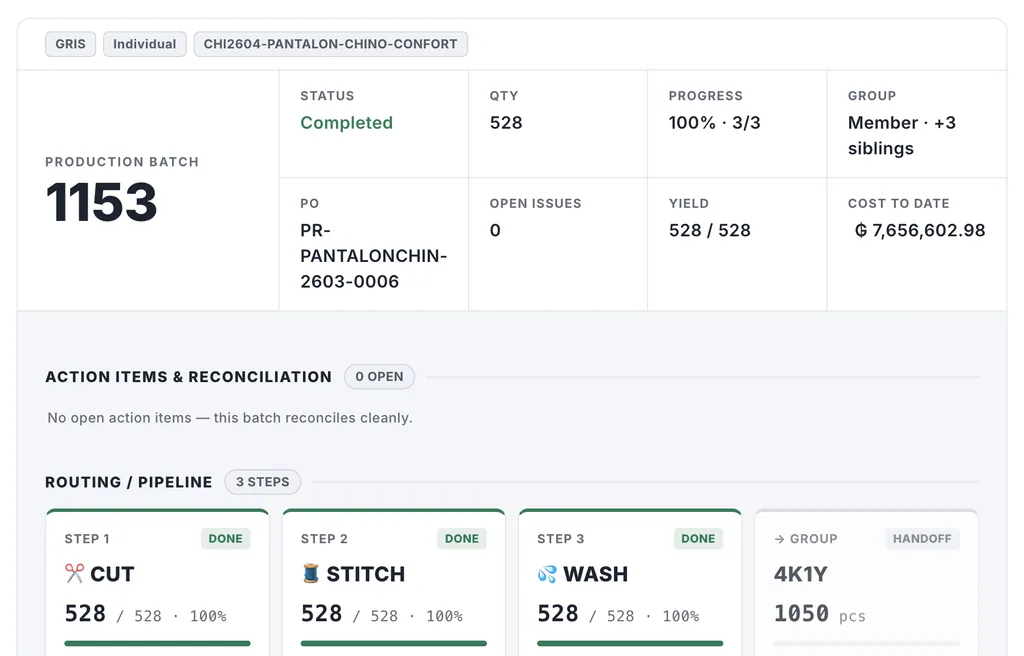
Batch cards record who did which operation on which batch, and how many pieces. The labour cost of a batch is therefore a recorded number, not the monthly total divided up afterwards — which is why cost per batch and cost per operation exist at all.
Where it lands →
40 hours a month
No longer spent building payroll from paper, across 50 employees at INDOPAR.
Connected to the rest
People are where the factory's largest cost starts. The scans on the line are the payroll and the labour cost at once, the skill matrix is what planning loads the lines against, and the training record is part of what an auditor asks to see.
A few we get asked
We pay by piece and it's complicated.
Batch cards handle assembly minutes and day rates side by side.
We already use a payroll provider.
Keep them. Start with labour cost per batch.
Our operators won't use an app.
They don't need to — supervisors record the batch card.
Priced by the size of your factory, not per user
Unlimited users on unlimited devices, every plan.
- Studio $179
- Factory M $450
- Factory L $900
- Factory XL $1,800
- Enterprise talk to us
Book a walkthrough
See your factory in GarmentFlow ERP.
Twenty minutes, no slides, a real factory's data on screen. We reply within one business day.
Faster on WhatsApp?
Message us →